Comparing Formula One and IndyCar: Differences Between the Race Cars
When it comes to the world’s premier open-wheel racing series, Formula 1 and IndyCar stand out as two of the most thrilling and competitive. While both feature powerful, single-seater machines built for speed, the cars themselves are quite different in design, technology, and purpose. This comparison focuses specifically on the cars used in each series, highlighting the key distinctions that define how they are built and how they perform on the track.
IndyCar:
1. Spec Chassis for All Teams:
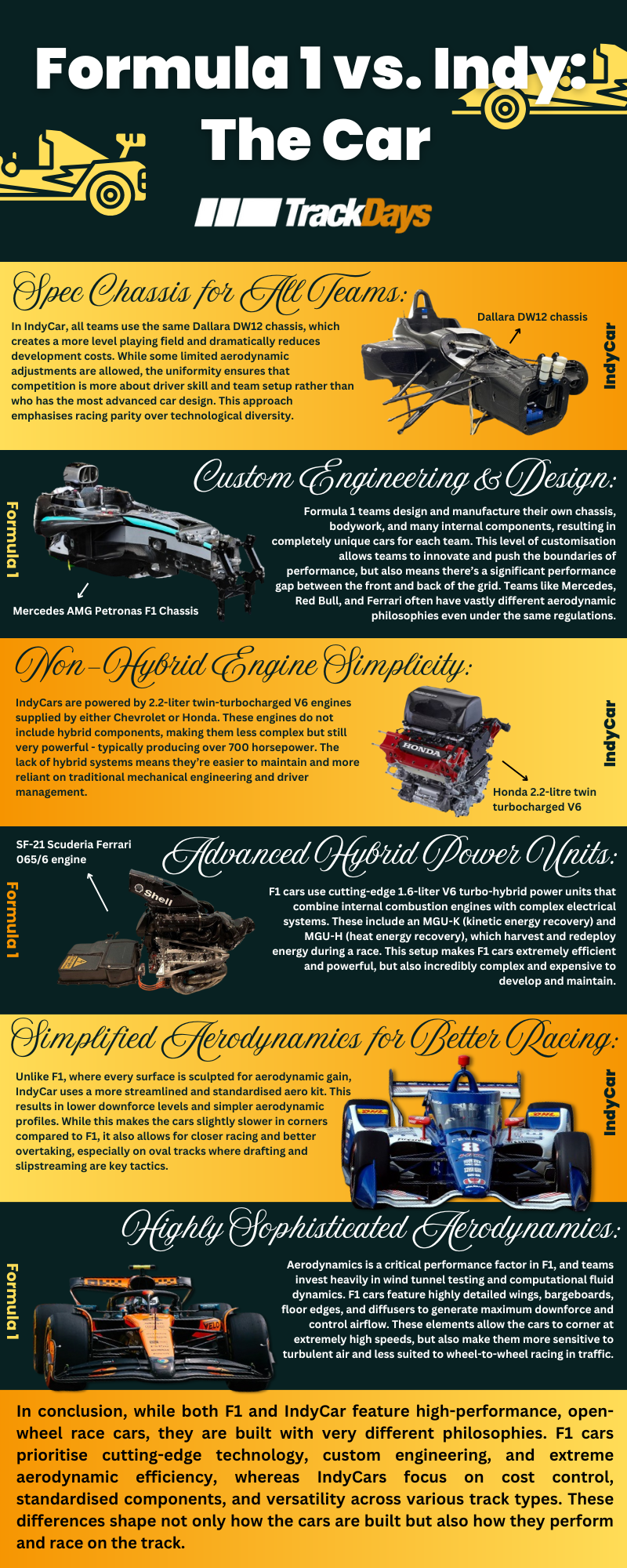
In IndyCar, all teams use the same Dallara DW12 chassis, which creates a more level playing field and dramatically reduces development costs. While some limited aerodynamic adjustments are allowed, the uniformity ensures that competition is more about driver skill and team setup rather than who has the most advanced car design. This approach emphasises racing parity over technological diversity.
2. Non-Hybrid Engine Simplicity:
IndyCars are powered by 2.2-liter twin-turbocharged V6 engines supplied by either Chevrolet or Honda. These engines do not include hybrid components, making them less complex but still very powerful - typically producing over 700 horsepower. The lack of hybrid systems means they’re easier to maintain and more reliant on traditional mechanical engineering and driver management.
3. Simplified Aerodynamics for Better Racing:
Unlike F1, where every surface is sculpted for aerodynamic gain, IndyCar uses a more streamlined and standardised aero kit. This results in lower downforce levels and simpler aerodynamic profiles. While this makes the cars slightly slower in corners compared to F1, it also allows for closer racing and better overtaking, especially on oval tracks where drafting and slipstreaming are key tactics.
Formula 1 Cars (F1):
1. Custom Engineering and Design:
Formula 1 teams design and manufacture their own chassis, bodywork, and many internal components, resulting in completely unique cars for each team. This level of customisation allows teams to innovate and push the boundaries of performance, but also means there’s a significant performance gap between the front and back of the grid. Teams like Mercedes, Red Bull, and Ferrari often have vastly different aerodynamic philosophies even under the same regulations.
2. Advanced Hybrid Power Units:
F1 cars use cutting-edge 1.6-liter V6 turbo-hybrid power units that combine internal combustion engines with complex electrical systems. These include an MGU-K (kinetic energy recovery) and MGU-H (heat energy recovery), which harvest and redeploy energy during a race. This setup makes F1 cars extremely efficient and powerful, but also incredibly complex and expensive to develop and maintain.
3. Highly Sophisticated Aerodynamics:
Aerodynamics is a critical performance factor in F1, and teams invest heavily in wind tunnel testing and computational fluid dynamics. F1 cars feature highly detailed wings, bargeboards, floor edges, and diffusers to generate maximum downforce and control airflow. These elements allow the cars to corner at extremely high speeds, but also make them more sensitive to turbulent air and less suited to wheel-to-wheel racing in traffic.
In conclusion, while both F1 and IndyCar feature high-performance, open-wheel race cars, they are built with very different philosophies. F1 cars prioritise cutting-edge technology, custom engineering, and extreme aerodynamic efficiency, whereas IndyCars focus on cost control, standardised components, and versatility across various track types. These differences shape not only how the cars are built but also how they perform and race on the track.
If all this talk of speed and precision has you eager to hit the track, a Single Seater or Race Car Experience is the perfect way to feel the thrill firsthand. It may not be the Indy 500 or Monaco Grand Prix, but it’s the closest you’ll get to that raw, adrenaline-fueled racing rush.
 0
£0
Basket
0
£0
Basket